


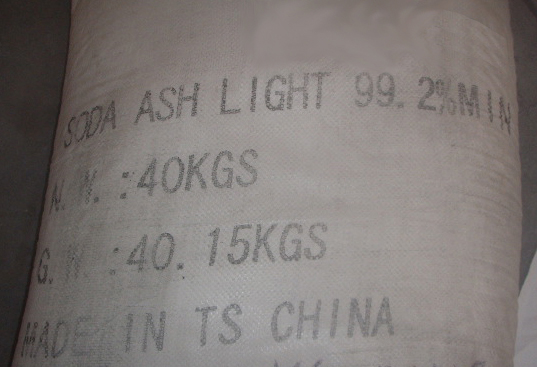
sodium carbonate
Price:Negotiable
Contact Info
- Add:Tianjin-based international trade centre,He Ping district,TianJin,China, Zip: 300051
- Contact: wangjuan
- Tel:+86-22-83522261
- Email:info@tjwolfsea.com
Other Products
Description
Additional Information
Soda ash light for industrial grade
Molecular formula: Na2CO3
Cas No.: 497-19-8
H.S.Code: 283620000
Molecular weight: 105.99 (in accordance with the international association of relative atomic mass in 1999)
Application: mainly used in chemical industry, glass-manufacturing, metallurgy, paper-manufacturing, textile, dyeing, synthetic detergent, soap, daily-use Chemical-industry, daily-use glass industry, washing powder, petrochemicals industry etc.
Commodity: soda ash light for industrial grade
spec. | Standard (%) | Result (%) |
Na2CO3 | ≥99.2 | 99.45-65 |
NaCL | ≤0.7 | 0.32-0.41 |
Fe | ≤0.004 | 0.00098-0.0013 |
SO4 | ≤0.03 | ≤0.03 |
Water Non-dissolved Matter% | ≤0.04 | 0.0098-0.010 |
Gross gravity (g/ml) | Around0.6 % |
Appearance: White crystal powder
Solubility: Easily soluble in water
Packing: 25kg/40kg per bag, 20MT/20'ft container without pallet
Storage: Soda ash should be stored under cover in a cool, dry place.
Use: Soda ash is widely used in chemical industry, metallurgical, defense, medical, petroleum, glass, food, enamel, flax, papermaking, cleaning water, and textile industry, etc.
Manufacturing Process
1)Solvay process:
Solvay Process centered around a large hollow tower. At the bottom, calcium carbonate (limestone) was heated to release carbon dioxide.
CaCO3 → CaO + CO2
At the top, a concentrated solution of sodium chloride and ammonia entered the tower. As the carbon dioxide bubbled up through it, sodium bicarbonate precipitated:
NaCl + NH3 + CO2 + H2O → NaHCO3 + NH4Cl
The sodium bicarbonate was then converted to sodium carbonate by heating it, releasing water and carbon dioxide:
2NaHCO3 → Na2CO3 + H2O + CO2
Meanwhile, the ammonia was regenerated from the ammonium chloride byproduct by heating it with lime (calcium hydroxide) left over from carbon dioxide generation:
CaO + H2O → Ca(OH)2
Ca(OH)2 + 2NH4Cl → CaCl2 + 2NH3 + 2H2O
Use: Soda ash is widely used in chemical industry, metallurgical, defense, medical, petroleum, glass, food, enamel, flax, papermaking, cleaning water, and textile industry, etc.
Manufacturing Process
1)Solvay process:
Solvay Process centered around a large hollow tower. At the bottom, calcium carbonate (limestone) was heated to release carbon dioxide.
CaCO3 → CaO + CO2
At the top, a concentrated solution of sodium chloride and ammonia entered the tower. As the carbon dioxide bubbled up through it, sodium bicarbonate precipitated:
NaCl + NH3 + CO2 + H2O → NaHCO3 + NH4Cl
The sodium bicarbonate was then converted to sodium carbonate by heating it, releasing water and carbon dioxide:
2NaHCO3 → Na2CO3 + H2O + CO2
Meanwhile, the ammonia was regenerated from the ammonium chloride byproduct by heating it with lime (calcium hydroxide) left over from carbon dioxide generation:
CaO + H2O → Ca(OH)2
Ca(OH)2 + 2NH4Cl → CaCl2 + 2NH3 + 2H2O
2)Combined Production Process (Hou's Process)
It is the same as the Solvay Process in the first few steps. But instead of treating the remaining solution with lime, carbon dioxide and ammonia is pumped into the solution and sodium chloride is added until it is saturated at 40 degree C. Then the solution is cooled down to 10 degree C. Ammonium chloride precipitates and its removed by filtration, the solution is recycled to produce more sodium bicarbonate. Hou's process eliminates the production of calcium chloride and the byproduct ammonium chloride can be used as a fertilizer.
Determination methods:
Determination of sodium carbonate content (GB 210.2-2004)
Reagent:
(1) Hydrochloric acid volumetric solution
(2) Bromocresol green-methyl red (indicator)
It is the same as the Solvay Process in the first few steps. But instead of treating the remaining solution with lime, carbon dioxide and ammonia is pumped into the solution and sodium chloride is added until it is saturated at 40 degree C. Then the solution is cooled down to 10 degree C. Ammonium chloride precipitates and its removed by filtration, the solution is recycled to produce more sodium bicarbonate. Hou's process eliminates the production of calcium chloride and the byproduct ammonium chloride can be used as a fertilizer.
Determination methods:
Determination of sodium carbonate content (GB 210.2-2004)
Reagent:
(1) Hydrochloric acid volumetric solution
(2) Bromocresol green-methyl red (indicator)
Soda ash dense for industrial grade
Molecular formula: Na2CO3
Cas No.: 497-19-8
H.S.Code: 283620000
Molecular weight: 105.99 (in accordance with the international association of relative atomic mass in 1999)
Application: mainly used in chemical industry, glass-manufacturing, metallurgy, paper-manufacturing, textile, dyeing, synthetic detergent, soap, daily-use Chemical-industry, daily-use glass industry, washing powder, petrochemicals industry etc.
Commodity: soda ash dense for industrial grade:
spec. | Standard (%) | Result (%) |
Na2CO3 | ≥99.2 | 99.45-99.75 |
NaCL | ≤0.7 | 0.25-0.50 |
Fe | ≤0.004 | 0.00098-0.0013 |
SO4 | ≤0.03 | ≤0.03 |
Water Non-dissolved Matter% | ≤0.04 | 0.0098-0.010 |
Retained on 180um sieve (%) | ≥70 | 83.0 |
Gross gravity (g/ml) | ≥0.9 | Around 1.05 |
Appearance: White crystal powder
Solubility: Easily soluble in water
Packing: 25kg/40kg per bag, 20MT/20'ft container without pallet
Storage: Soda ash should be stored under cover in a cool, dry place.
Use: Soda ash is widely used in chemical industry, metallurgical, defense, medical, petroleum, glass, food, enamel, flax, papermaking, cleaning water, and textile industry, etc.
Manufacturing Process
1)Solvay process:
Solvay Process centered around a large hollow tower. At the bottom, calcium carbonate (limestone) was heated to release carbon dioxide.
CaCO3 → CaO + CO2
At the top, a concentrated solution of sodium chloride and ammonia entered the tower. As the carbon dioxide bubbled up through it, sodium bicarbonate precipitated:
NaCl + NH3 + CO2 + H2O → NaHCO3 + NH4Cl
The sodium bicarbonate was then converted to sodium carbonate by heating it, releasing water and carbon dioxide:
2NaHCO3 → Na2CO3 + H2O + CO2
Meanwhile, the ammonia was regenerated from the ammonium chloride byproduct by heating it with lime (calcium hydroxide) left over from carbon dioxide generation:
CaO + H2O → Ca(OH)2
Ca(OH)2 + 2NH4Cl → CaCl2 + 2NH3 + 2H2O
Use: Soda ash is widely used in chemical industry, metallurgical, defense, medical, petroleum, glass, food, enamel, flax, papermaking, cleaning water, and textile industry, etc.
Manufacturing Process
1)Solvay process:
Solvay Process centered around a large hollow tower. At the bottom, calcium carbonate (limestone) was heated to release carbon dioxide.
CaCO3 → CaO + CO2
At the top, a concentrated solution of sodium chloride and ammonia entered the tower. As the carbon dioxide bubbled up through it, sodium bicarbonate precipitated:
NaCl + NH3 + CO2 + H2O → NaHCO3 + NH4Cl
The sodium bicarbonate was then converted to sodium carbonate by heating it, releasing water and carbon dioxide:
2NaHCO3 → Na2CO3 + H2O + CO2
Meanwhile, the ammonia was regenerated from the ammonium chloride byproduct by heating it with lime (calcium hydroxide) left over from carbon dioxide generation:
CaO + H2O → Ca(OH)2
Ca(OH)2 + 2NH4Cl → CaCl2 + 2NH3 + 2H2O
2)Combined Production Process (Hou's Process)
It is the same as the Solvay Process in the first few steps. But instead of treating the remaining solution with lime, carbon dioxide and ammonia is pumped into the solution and sodium chloride is added until it is saturated at 40 degree C. Then the solution is cooled down to 10 degree C. Ammonium chloride precipitates and its removed by filtration, the solution is recycled to produce more sodium bicarbonate. Hou's process eliminates the production of calcium chloride and the byproduct ammonium chloride can be used as a fertilizer.
Determination methods:
Determination of sodium carbonate content (GB 210.2-2004)
Reagent:
(1) Hydrochloric acid volumetric solution
(2) Bromocresol green-methyl red (indicator)
It is the same as the Solvay Process in the first few steps. But instead of treating the remaining solution with lime, carbon dioxide and ammonia is pumped into the solution and sodium chloride is added until it is saturated at 40 degree C. Then the solution is cooled down to 10 degree C. Ammonium chloride precipitates and its removed by filtration, the solution is recycled to produce more sodium bicarbonate. Hou's process eliminates the production of calcium chloride and the byproduct ammonium chloride can be used as a fertilizer.
Determination methods:
Determination of sodium carbonate content (GB 210.2-2004)
Reagent:
(1) Hydrochloric acid volumetric solution
(2) Bromocresol green-methyl red (indicator)
Soda ash for food grade
Molecular formula: Na2CO3
Cas No.: 497-19-8
H.S.Code: 283620000
Molecular weight: 105.99 (in accordance with the international association of relative atomic mass in 1999)
Application: mainly used in chemical industry, glass-manufacturing, metallurgy, paper-manufacturing, textile, dyeing, synthetic detergent, soap, daily-use Chemical-industry, daily-use glass industry, washing powder, petrochemicals industry etc.
Commodity: soda ash for food Grade:
spec. | Standard (%) | Result (%) |
Na2CO3 | ≥99.2 | 99.40-99.60 |
NaCL | ≤0.7 | 0.35-0.55 |
Fe | ≤0.0035 | 0.00090-0.0015 |
SO4 | ≤0.03 | ≤0.03 |
Moisture Content % | 0.1%-0.4% | 0.1%-0.4% |
Water Insoluble Matter% | ≤0.03 | 0.0090-0.015 |
Heavy Metal (As Pb) % | ≤0.001 | ﹤0.001 |
Arsenic(%) | ≤0.0002 | ﹤0.0002 |
Packing: 25kg/40kg/50kg/1,000kg per bag, 20MT/20’ft container without pallet and 17.5MT/20’ft container with pallet or as per customer’s requirement
Manufacturing Process
1)Solvay process:
Solvay Process centered around a large hollow tower. At the bottom, calcium carbonate (limestone) was heated to release carbon dioxide.
CaCO3 → CaO + CO2
At the top, a concentrated solution of sodium chloride and ammonia entered the tower. As the carbon dioxide bubbled up through it, sodium bicarbonate precipitated:
NaCl + NH3 + CO2 + H2O → NaHCO3 + NH4Cl
The sodium bicarbonate was then converted to sodium carbonate by heating it, releasing water and carbon dioxide:
2NaHCO3 → Na2CO3 + H2O + CO2
Meanwhile, the ammonia was regenerated from the ammonium chloride byproduct by heating it with lime (calcium hydroxide) left over from carbon dioxide generation:
CaO + H2O → Ca(OH)2
Ca(OH)2 + 2NH4Cl → CaCl2 + 2NH3 + 2H2O
2)Combined Production Process (Hou’s Process)
It is the same as the Solvay Process in the first few steps. But instead of treating the remaining solution with lime, carbon dioxide and ammonia is pumped into the solution and sodium chloride is added until it is saturated at 40 degree C. Then the solution is cooled down to 10 degree C. Ammonium chloride precipitates and its removed by filtration, the solution is recycled to produce more sodium bicarbonate. Hou’s eliminates the production of calcium chloride and the byproduct ammonium chloride can be used as a fertilizer.
Determination methods:
Determination of sodium carbonate content (GB 210.2-2004)
Reagent:
(1) Hydrochloric acid volumetric solution
(2) Bromocresol green-methyl red (indicator)
mainly used in chemical industry, glass-manufacturing, metallurgy, paper-manufacturing, textile, dyeing, synthetic detergent, soap, daily-use Chemical-industry, daily-use glass industry, washing powder, petrochemicals industry etc.
CAS NO:497-19-8;7542-12-3
EC NO:207-838-8;231-420-4
Molecular Formula:Na2CO3
Molecular Weight:105.99
Synonyms:;Sodium carbonate anhydrous;Sodium carbonate solution;soda ash;disodium carbonate;Sodium carbonate-12C, 13C-depleted;calcined soda;Carbonic acid disodium salt;Sodium carbonate,high-purity;Sodium carbonate,dense;SODA ASH LIGHT;Anhydrous Sodium carbonate;carbonic acid, sodium salt;Carbonic acid, sodium salt;Caswell No. 752;Soda (VAN);Soda;Sodium carbonate,anhydrous;
Molecular Structure: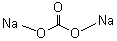
| Industry Category | Chemicals/Inorganic Salts/Carbonates |
|---|---|
| Product Category | |
| Brand: | |
| Spec: | |
| Stock: | |
| Origin: |


